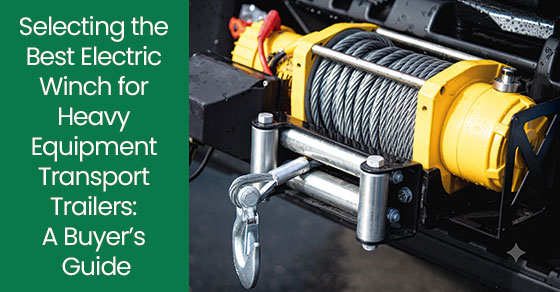
On a job site or transport route, a winch that can’t keep pace with the load it’s asked to move turns a routine task into a costly delay. Choosing the right electric winch for a heavy equipment trailer isn’t as simple as matching a number on a spec sheet to a number on an equipment label.
Capacity, duty cycle, build quality, and electrical compatibility all factor into whether a winch performs reliably for years or becomes a recurring problem within months. In this guide, we break down what separates a dependable electric winch from one that falls short.
The Sturdy Build Behind a Reliable Electric Winch
A unit mounted on a heavy equipment transport trailer doesn’t get the luxury of gentle use. It sits outdoors through weather extremes, gets loaded and unloaded daily, and is expected to perform the same way on its thousandth cycle as it did on its first. What makes that possible is the combination of housing material, gear train construction, sealing quality, and motor design working together under repeated stress.
How to Choose the Best Electric Winch for Heavy Equipment Transport Trailers
Five factors separate a winch that performs reliably for years from one that becomes a recurring maintenance line item:
- Match pulling capacity to load conditions
The common sizing mistake in procurement is matching a winch’s rated capacity directly to equipment weight, as if the two numbers should line up. In practice, the force required to move machinery up a ramp depends on rolling resistance, the angle of the incline, surface conditions, and whether the load starts from a dead stop or is already in motion.
Rated only against equipment weight on paper, a heavy-duty winch will struggle once friction and incline enter the equation. Buyers should also distinguish between breaking strength, the point at which a component fails, and rated working capacity, the safe operating threshold with a margin built in. Sizing against actual loading conditions prevents a winch from routinely operating near its limit.
- Check the duty cycle against the loading frequency
Every electric winch carries a duty cycle rating. It is expressed as a ratio of run time to requested rest time, such as running for a set number of seconds at full back before needing several minutes to cool down.
Loading one machine per stop a few times a week creates a very different thermal load than cycling multiple pieces of equipment across several trailers within a single shift. Motor type is also important, as series-wound motors tend to tolerate sustained use better compared to permanent magnet motors. A winch that relies on its thermal overload switch regularly signals a duty cycle mismatched to the job from the start.
- Evaluate gear train and braking system quality
Gear ratio and construction determine how much control an operator has during a pull and how efficiently motor power converts into usable pulling force. The braking system deserves just as much attention. An automatic load-holding brake keeps heavy equipment from rolling back the moment power is released or the operator lets go of the control. This always comes in handy since the load is often left resting on an incline between pulls while the operator repositions or secures other equipment.
A sealed and corrosion-resistant gear housing is also worth inspecting closely. It’s a reasonable proxy for how the unit will hold up over years of outdoor service rather than a few months before parts start wearing down.
- Confirm electrical compatibility with trailer setup
Rated capacity alone doesn’t guarantee performance. If the electrical system feeding the trailer winch can’t keep up with its draw, that capacity number won’t translate into a strong pulling number. Battery capacity is one piece of this picture, and voltage drop across longer cable runs is another, since a current weakens the farther it travels before reaching the motor. Compatibility with the low vehicle’s charging systems rounds out the equation.
Together, these factors determine the steady current a trailer winch receives under load (regardless of the spec sheet promises). Fleets running winches across multiple trailers should confirm that auxiliary power setups stay consistent fleet-wide, so performance doesn’t vary unpredictably from one trailer to the next.
- Prioritize sealing and environmental protection
Electric winches on transport trailers rarely operate in controlled indoor conditions. Rain, dust, temperature swings, and road grime kicked up during transit all work steadily against unsealed components over time. An ingress protection rating, a properly sealed control box, and corrosion-resistant hardware keep the internal gear train and electronics functioning years after installation. In essence, sealing is where that engineering investment pays off or falls short when failure is least convenient.
Hydraulic vs. Electrical Winches: Which Type Fits Every Application?
Electric winches handle a wide range of trailer loading well, particularly for intermittent use and standard electrical setups where battery and charging capacity are genuinely sufficient. For a large share of fleets, that’s exactly the right fit.
The picture changes for continuous-duty operations. Fleets cycling heavy equipment frequently, working in extreme climates, or operating in marine, offshore, or other demanding environments usually push electric systems toward their thermal and electrical limits faster than expected.
Heat buildup during sustained pulling is the central constraint. Hydraulic systems dissipate heat through fluid circulation rather than relying on a motor to rest between cycles. This work-mode type allows a heavy-duty winch built on hydraulic power to sustain more pulling force across long duty cycles without the rest periods an electric unit requires.
For teams thinking fleet-wide, the right question is which technology matches the operational tempo the fleet runs day to day.
Why Fleets Trust Hydraulic Winch Co. for Heavy-Duty Performance
For operations that have outgrown what an electric winch can sustain, Hydraulic Winch Co. builds systems designed to keep working through continuous duty demands. Based in Pendleton, Oregon, our small, dedicated team manufactures:
- Heavy-duty hydraulic winches
- Offshore and marine winches
- Marine anchor winch systems
- Hydraulic capstan and bayonet winches
- Hydraulic power packs
- Manhole kits
- Rope kits designed to suit industrial applications
Our equipment and craftsmanship guide every unit that leaves our shop. When an application calls for performance that doesn’t pause to cool down, our hydraulic systems are the dependable choice. Talk to us today at 888-413-6459 or contact us online to discuss the right heavy-duty winch solution for your needs.