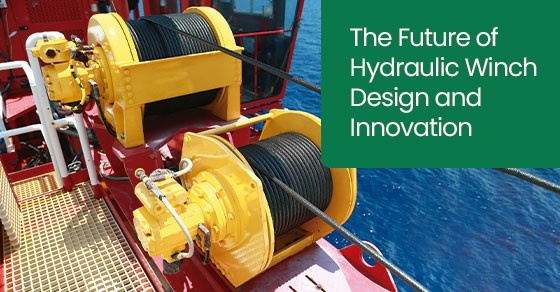
What does progress look like in heavy pulling and lifting today? Many industries are undergoing simultaneous changes. For instance, marine crews face deeper waters and longer operations. Rail, agriculture, and fibre cable teams want equipment that works harder, but also makes the job safer and easier.
So, the expectations are rising. Strength alone is not enough anymore. A system must respond smoothly, hold steady under heavy loads, and stay dependable through long service hours.
This is exactly where modern winch design takes shape. New hydraulic solutions now integrate precision and durability into design. The future feels closer than ever.
What’s driving the future of winch design?
Today, loads are heavier and project timelines move faster. Operators manage tougher tasks with smaller crews. Decision-makers now choose hydraulic solutions based on how well they perform across different job conditions. Here is what they now look for:
- Higher torque performance: A modern winch design must be able to pull heavy loads easily. Power must be steady and repeatable, especially during long shifts.
- Reliable control under a load: Operators need fine movement. They must be able to start, slow, and stop the drum.
- Integration with existing hydraulic solutions: The winch should be compatible with systems on the vessel, vehicle, or site. This reduces downtime, retraining, and extra installation costs.
- Lower maintenance demands: Longer-lasting parts keep crews working and equipment in service, rather than in repair shops.
Across industries, innovation trends now focus on systems that perform and support operators. Modern winch design must strike a balance between these needs.
Performance Under Pressure: Why Hydraulic Solutions Still Lead
Compared with alternatives like electric winch design, hydraulic systems continue to lead in heavy-duty work. They are perfect for rough weather, uneven surfaces, and long operating hours.
This is where hydraulic power stands out:
- Consistent force output: Hydraulic pressure delivers steady pulling power. It does not weaken when the load increases. This consistency is important for long-haul cable pulls, ship anchoring, or heavy transport rigging.
- Fine movement control: Operators need accuracy. Hydraulic solutions allow slow inching, gradual tensioning, and careful stops. A small valve adjustment creates a precise shift in drum movement, reducing strain, protecting the cable, and increasing safety.
- Reliable in wet, harsh, offshore, or remote conditions: Marine salt spray, cold rail yards, dusty farm fields, offshore vibration, and storm changes do not interrupt hydraulic systems. They are sealed, cooled by a fluid, and designed for continuous operation.
While electric systems have strengths, they are used for lighter loads or controlled indoor environments. Heavy industry still chooses hydraulic solutions because they perform under pressure. This is why there is constant demand for advanced winch design.
Application-Driven Innovation Trends in Industrial Winching
Innovation trends in winching do not start in a factory; they begin in the field. Different industries push equipment in different ways. Engineers learn from tasks, weather conditions, and operators. Modern winch design grows from these day-to-day demands, not theory.
Marine and Offshore
This sector works on moving water. Deck cranes, lifting barges, anchor handling, and pipeline operations all depend on stable pulling power. Salt, wind, and waves add stress every hour.
- What matters most: Resistance to corrosion and stable tension during movements.
- How winch design is evolving: Strong sealing is essential. Most designs now come with stainless steel and coated metals. Load-sensing valves are added for better controlled force.
Heavy Transport and Rail
Rail yards, recovery vehicles, and transport haulers rely on winches to shift heavy loads. Work often occurs quickly, often around people and other equipment.
- What matters most: Safe operation and flexible mounting.
- How design is evolving: Modular mounting kits and stronger braking systems are being used. Additionally, more intuitive operator controls have been added.
Agriculture
Farm machinery operates in harsh conditions, including dust, mud, heat, and rain. Equipment must be durable and easy to repair.
- What matters most: Long service life and easy upkeep.
- How design is evolving: Simplified hydraulic routing is now in use. Systems also feature stronger bearings and more durable drums.
Fibre and Cable Pulling
Utility crews pull lines through trenches or over distances. The rope must stay intact, and tension must remain steady.
- What matters most: Smooth pull and low cable damage.
- How design is evolving: A tension control system is now common. Rope-friendly drum profiles are included.
Across all sectors, innovation trends are leaning towards providing better performance feedback for operators. Engineers also improve rope and drum compatibility to protect lines during heavy use.
The Road Ahead: Where Innovation Is Moving Next
The next phase of progress is fast-moving. Industry teams want winches that provide power and control in smaller, smarter forms.
- We will see more modular winch designs. Frames and mounting setups can be easily shifted between trucks, barges, skids, rail platforms, or field equipment. This innovation erases any form of time-wasting.
- Control systems will grow smarter. Load-sensing technology will match power output to real pulling conditions. This protects the operator and equipment. Energy is also saved.
- Wireless connectivity will expand. Operators will control movement from safer distances.
- Power setups will also become more flexible. This will allow easier pairings across multiple hydraulic power packs.
Innovation trends will continue to move towards winches that are easier to use, safer to run, and faster to deploy.
Industries Depend on Hydraulic Winch Co. for Utility-Based Designs
At Hydraulic Winch Co., we design winches for real work. Every unit is built in Pendleton, Oregon, with a commitment to quality control and long service life.
Our goal is to enable crews to feel confident every time the line moves. Our winch design approach is always grounded in utility, not excess. It enables strong handling, smooth movement, and durable parts that withstand tough environments.
Our product range includes:
- Offshore hydraulic winches
- Marine winches
- Marine anchor winch systems
- Heavy-duty hydraulic winches
- Capstan and Bayonet winches
- Hydraulic power packs
- Manhole kits
- Rope options structured to load and line type
Additionally, we have the best accessories to help teams work smarter.
If you need steadier control under heavy loads, the dual counterbalance valve for stable load control comes in handy. We also design foot control valves for hands-free work and ladder pulleys for tight routing in small spaces.
To request a quote or discuss project-specific needs, call us at 888-413-6459 or contact us online. Our engineers will evaluate your load requirements and control preference to guide you towards the best winch design.